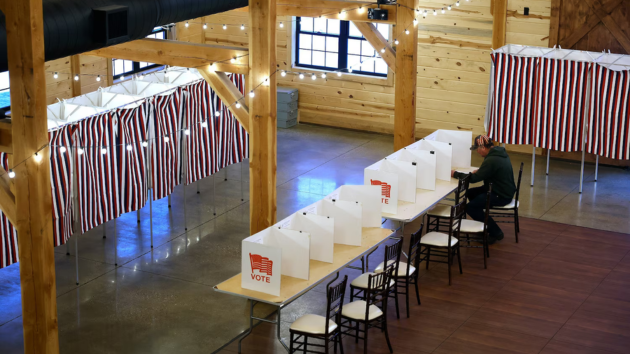
 Voters cast their ballots in the New Hampshire presidential primary election at The Barn at Bull Meadow, January 23, 2024, in Concord, New Hampshire. Chip Somodevilla/Getty Images
(WASHINGTON) -- Friday marks a key procedural deadline for how Democrats will figure out which states will hold the first presidential nominating contests of 2028, amid broader debates within the party over diversity and voter representation, and which states will show which candidates are viable for the long haul.
The Democratic National Committee set a Friday afternoon deadline for state parties to apply to have their 2028 presidential nominating contests be held in the period before Super Tuesday, the first Tuesday in March during a presidential calendar year where the most primaries are held.
The order of the primaries and caucuses matters because the early contests help indicate which candidates have momentum and are striking a chord with voters, and often narrow the candidate field ahead of Super Tuesday.
The debate about the order is also about diversity and voter representation in the Democratic Party. Some Democrats have argued that states with larger Black and minority populations should be prioritized, to reflect the diversity of the country, while others say the party should prioritize traditional "early states," such as New Hampshire, to spur turnout and buzz, even though their populations may be less diverse.
Traditionally, Iowa has held first-in-the nation caucuses and New Hampshire has first-in-the-nation primaries. But in 2024, a reshuffled DNC primary calendar pushed the states from the first two slots on the party’s official calendar and officially put South Carolina first.
While Iowa Democrats found a compromise with the DNC by switching their in-person caucus to an entirely mail-in voting process, New Hampshire’s primaries were kept in January, causing conflict between the state and national party.
Iowa Democratic Party Chair Rita Hart, in a statement to ABC News, said that the party is applying to hold its caucuses before Super Tuesday, and said Democrats need to keep Iowa toward the front of the line in order to stay competitive with Republicans.
"No matter what the Rules and Bylaws Committee decides, Republican presidential candidates will be in Iowa," Hart wrote. "It was a mistake for the DNC to cut us out of the calendar, letting Republicans' attacks go unanswered in Iowa while millions of dollars in advertising, organizing and the worldwide media flooded our state."
Some state party leaders have said their states being early in the calendar will help candidates show if they can stick it out throughout 2028.
New Hampshire Democratic Party Chair Raymond Buckley said the case his party is making to the DNC is that New Hampshire is a prime state for 2028 candidates to build up support and to show their viability. He said its small size allows for easy campaigning in a purple state, "which is exactly what you need in the November general election."
New Hampshire also has a state law requiring it to hold the nation's first presidential primaries, which is what led in large part to the disarray in 2024 between the state party and the DNC. But Buckley said that it's not a factor right now.
"It's not about the tradition, it's not about the law; it's really about our involvement, and we just think that we have an unmatched record of being able to give the opportunity for candidates to talk to voters one-on-one," Buckley said.
Buckley said New Hampshire's population of union members, as well as the large percentage of students of color in the public school systems of the state’s two largest cities make it a great state for candidates to test the waters.
But the South Carolina Democratic Party said it wants to stay first in the calendar.
Party Executive Director Jay Parmley told ABC News that the state is making its case to the DNC to remain in the early window because it's compact and allows unknown candidates to compete. Also, Parmley said the state does not have a major population center, so candidates need to fan out across it.
Regarding the debates surrounding diverse primary states, Parmley pointed to how the state has a "diverse electorate," and highlighted its Black community. Around 1 in 4 registered voters in South Carolina are Black, according to data from the South Carolina Election Commission.
"Our Black electorate -- it legitimizes and rewards the role of Black voters and as the backbone and soul, if you will, of the Democratic Party."
Nevada's Democratic Party also confirmed it's submitting a bid to go early, arguing that galvanizing the state's minority and working-class populations is critical for the Democrats.
In a draft of their application, the state party wrote, "The Democratic Party is facing a critical moment where we must be strategic in our efforts to earn back Latino support, craft an economic message that resonates across the country, begin the work to reach working-class voters, and turn out diverse communities. We cannot afford to have overwhelmingly college-educated, white, or less competitive states kick off the process of selecting our party’s nominee."
Michigan is also submitting a bid to be among the early states similar to how it was in 2024, the state's party confirmed to ABC News -- arguing in part that Michigan is the most important and diverse of the battleground states.
"For Democrats to have the strongest presidential candidate, the early nominating states should closely mirror Democratic voters nationwide and be representative of America," Michigan Democratic Party Chair Curtis Hertel said in a statement to ABC News.
Illinois', North Carolina's and Georgia's state Democratic parties also confirmed to ABC News that they are submitting bids. As Georgia's state’s presidential primaries are usually held after Super Tuesday, they’d have to work with the Republican-dominated state legislature to move up the date.
Copyright © 2026, ABC Audio. All rights reserved.